Frank Schnorrer How do our muscles build, repair themselves and resist ageing?
CNRS researcher, head of the “Muscle dynamics” team at Institut de Biologie du Développement de Marseille. Frank Schnorrer's websiteWebsite of the Institute of Developmental Biology in Marseille
2026 • Impulscience
2016 • Bettencourt prize for young researchers
Walking, running, lifting an object… Behind every movement lies a remarkably complex cellular machinery. Frank Schnorrer explores the mechanisms that enable muscle cells to build their complex architecture during development. These mechanisms also allow them to maintain their function throughout life by adapting to the stresses of ageing.
What gives our muscles their strength
Skeletal muscles account for around 40 per cent of human body weight and enable us to perform all voluntary body movements. To do so muscle cells have unique characteristics that distinguish them from other cell types in the human body. In particular, they contain force-generating units (sarcomeres), a large number of energy-producing mitochondria, and thousands of nuclei within a single muscle cell.
Whilst each of these components has been extensively studied in isolation, the mechanisms that coordinate their organisation within the muscle cells remain poorly understood. Only a well organised muscle cell can effectively produce forces.
-
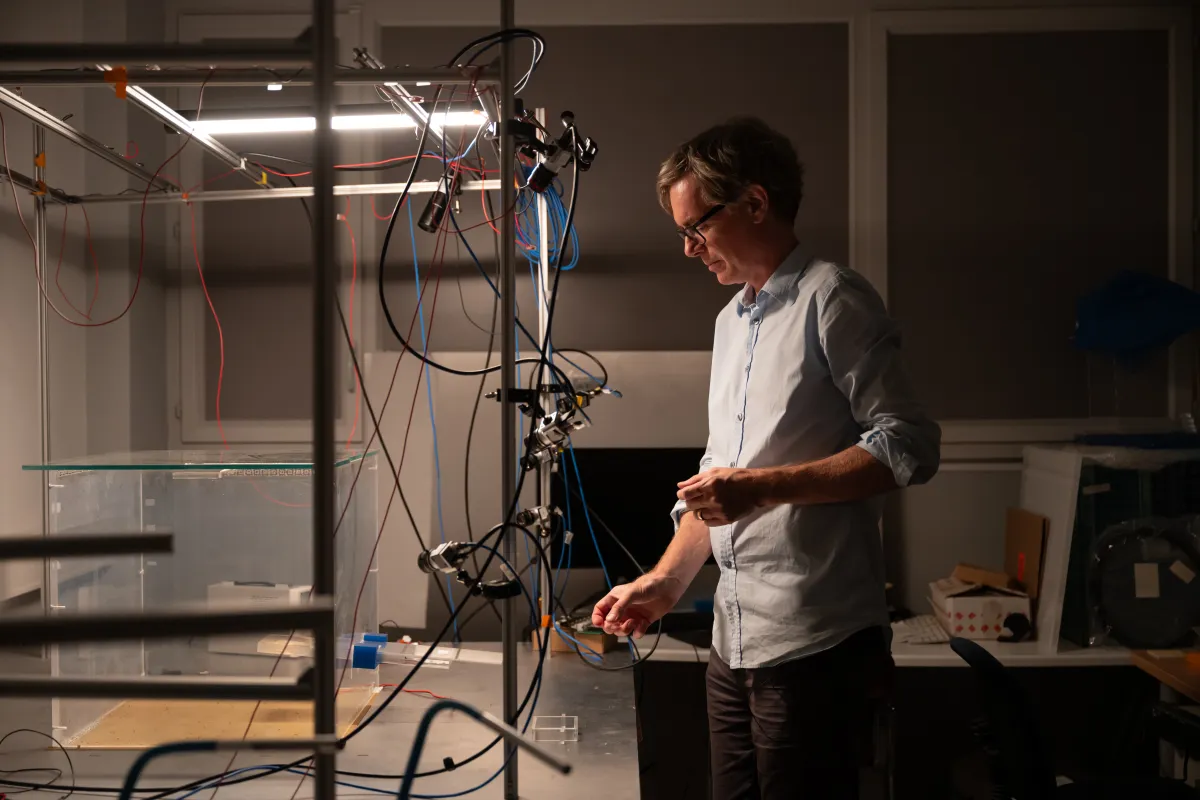
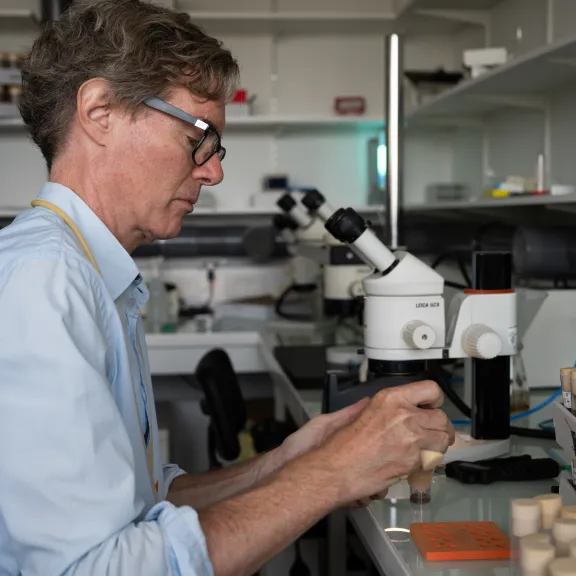
In Frank Schnorrer’s laboratory.
© Alexandre Darmon / Art In Research -
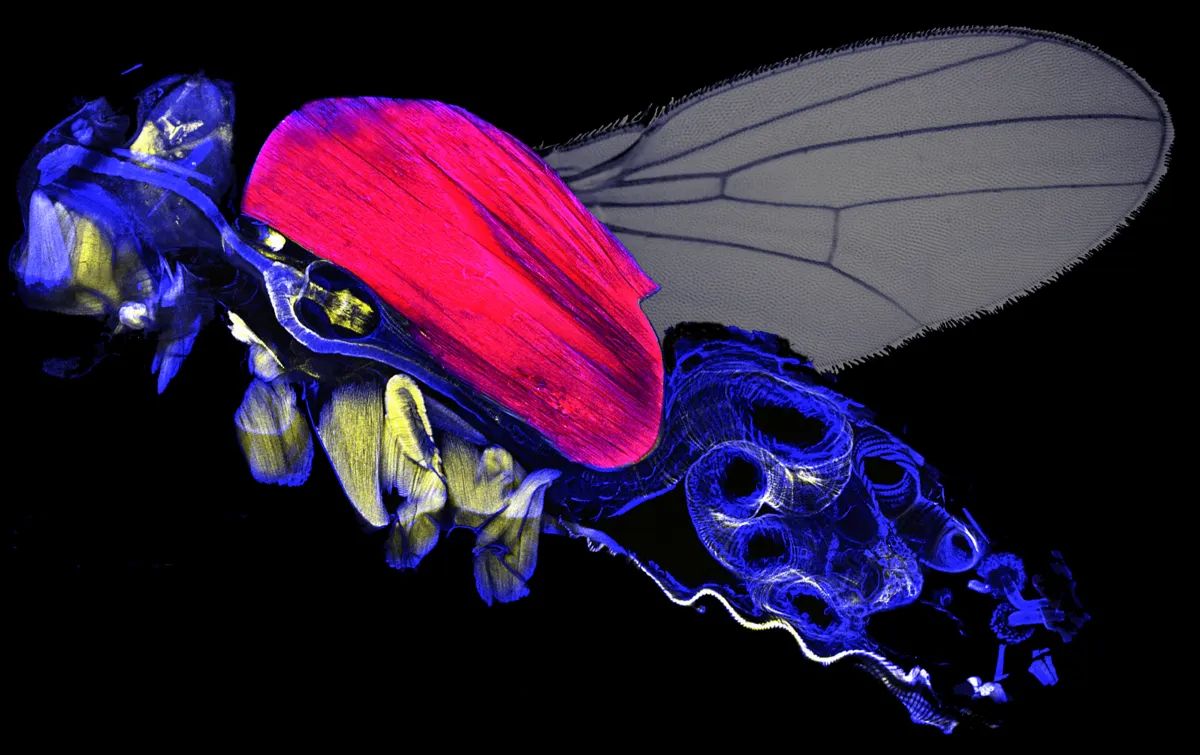
A cross-section of an adult fruit fly showing the flight muscles in red, the head and leg muscles in yellow, and the other cells in blue.
© Equipe de Frank Schnorrer / Institut de Biologie du Développement de Marseille -
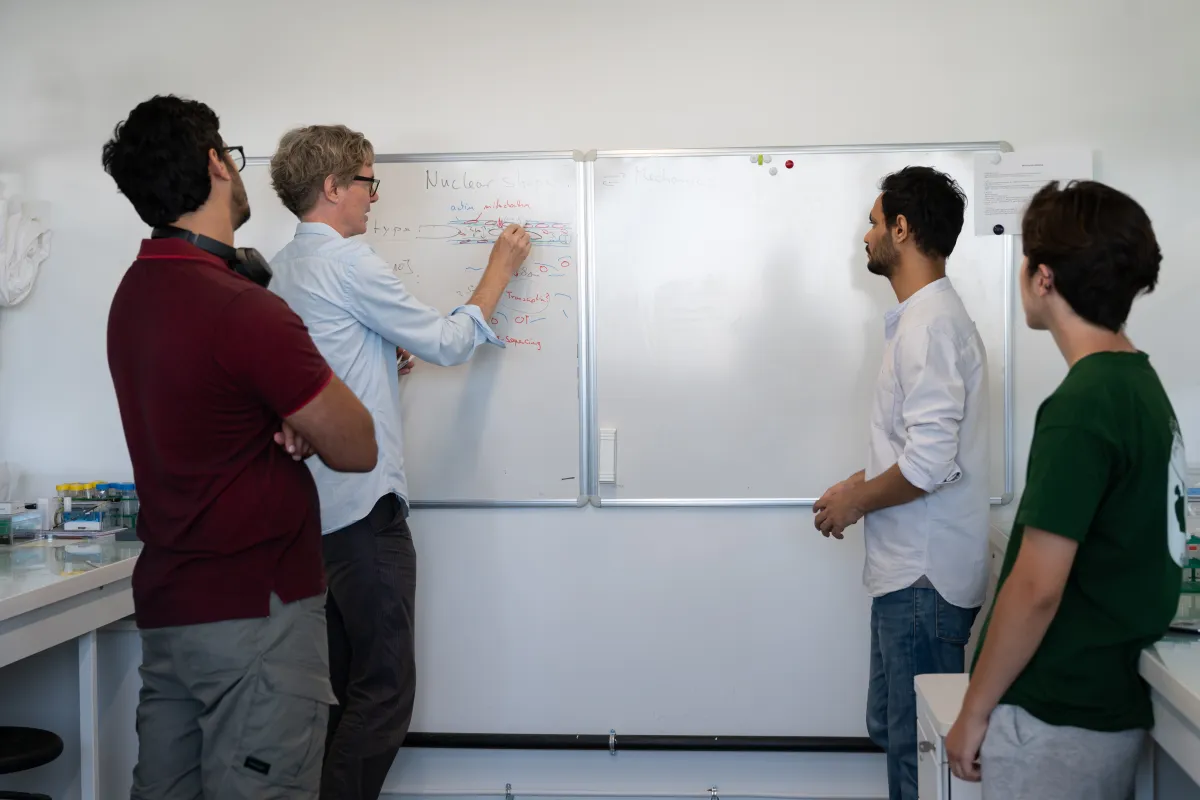
Frank Schnorrer and his team.
© Alexandre Darmon / Art In Research -
In Frank Schnorrer’s laboratory.
© Alexandre Darmon / Art In Research -
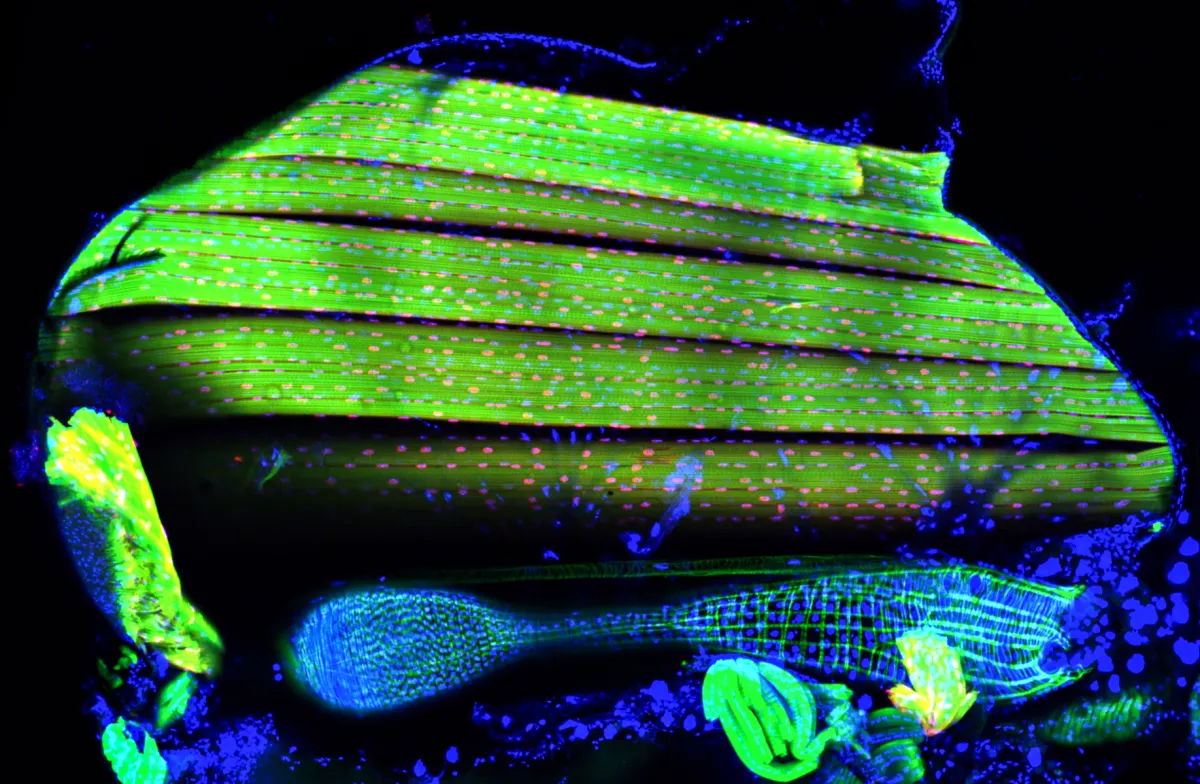
A preparation reveals the details of the fruit fly’s flight muscles, shown in green, and their nuclei, shown in red. All other nuclei appear in blue.
© Equipe de Frank Schnorrer / Institut de Biologie du Développement de Marseille -
In Frank Schnorrer’s laboratory.
© Alexandre Darmon / Art In Research
On muscle development…
Frank Schnorrer is interested in the mechanisms that orchestrate, in time and space, the development of muscles. His hypothesis is that mechanical forces constitute a biological language enabling the various compartments of each muscle cell – nuclei, sarcomeres and mitochondria – to exchange information and act in a coordinated manner to together build a functional muscle cell.
To test the force language hypothesis, he and his team will use the support by Impulscience and combine genetic manipulation techniques with advanced microscopy using two models: the fruit fly (Drosophila) and human muscle cells grown in culture. These complementary approaches will help to identify how the fundamental mechanisms observed in the fruit fly are conserved in humans to build functional muscles.
…as they age
Armed with these tools, Frank Schnorrer will seek to better understand how muscles age in a healthy state: How do cell nuclei detect and respond to mechanical changes within the cell? How do muscle cells detect and repair the damage that accumulates with age? This is particularly important as muscle cells are long lived – we die with the same heart cells with which we have been born.
By shedding light on the mechanisms linking muscle architecture to function and ageing, this project could open up new avenues for understanding – and ultimately limiting – muscle loss associated with ageing or common muscle diseases.
Frank Schnorrer in a few words
After completing his PhD at the Max Planck Institute for Developmental Biology in Tübingen, Frank Schnorrer undertook postdoctoral research at the Institute of Molecular Pathology in Vienna, before going on to lead his own research group at the Max Planck Institute of Biochemistry in Martinsried, Germany. In 2016, he joined the Institute of Developmental Biology in Marseille thanks to an A*Midex Chair of Excellence and the The Coups d'élan prize for French research awarded by the Fondation Bettencourt Schueller. Since 2025, he has been a Research Director of Exceptional Class at the CNRS and was recently elected to the Academia Europaea.
Worth reading
Anaïs Bailles
Dmitry Karpov
Lisa Roux